

Escapement
The mechanism that meters the release of stored energy from a mechanical movement and maintains the oscillator’s motion.
Also known as: watch escapement, escapement mechanism
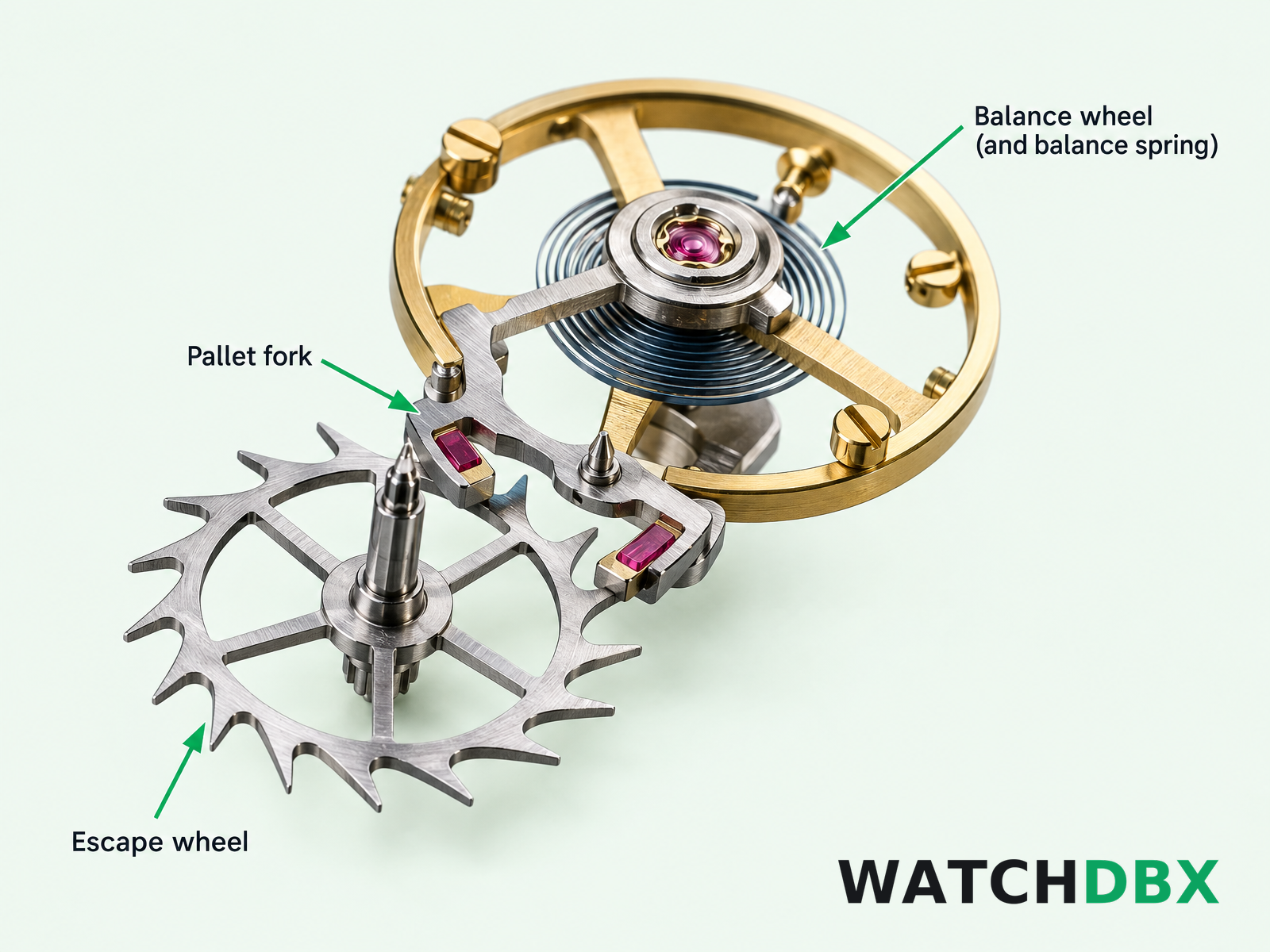
Definition
The escapement is the mechanism that meters energy from the gear train and couples it to the watch's oscillator. In the common Swiss lever system, the escape wheel is alternately locked and released by the pallet fork, while the fork gives periodic impulses to the balance wheel. The oscillator in turn controls the timing of each release. This feedback relationship lets the mainspring unwind gradually rather than dumping its energy at once. Different escapement designs pursue different balances of efficiency, robustness, lubrication needs and precision.
Why it matters
The escapement sits at the heart of mechanical timekeeping: it determines how energy reaches the oscillator and is a major source of friction and energy loss. Its design affects efficiency, reliability, servicing and technical interest.